The Primary Addiction That We All Suffer

We all know about substance addictions and we have heard about some “process” addictions like gambling. Recently, more attention has been paid to sexual addictions (a double-hot issue since both sex and addiction are loaded with shame, for some reason). If we have managed to avoid these dreaded conditions then are we in the clear? Nope. We still have the very first addiction, and the most insidious.
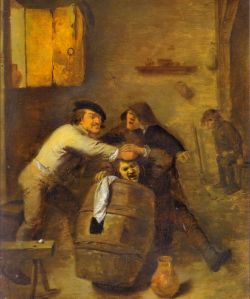
Peasants Quarrelling in an Interior - Adriaen Brouwer

Peasants Quarreling in an Interior – Adriaen Brouwer – 1630

Our primary addictions are to serenity strategies, set up in early childhood when the ego is getting organized. Emotion is the energy that keeps us attached (addicted) to our (largely unconscious) strategies. When things go well we are temporarily content. When the world does not cooperate, we have a variety of afflictive emotions and we double down on the strategy. Life is a see-saw battle with an elusive destination.

Thomas Keating identified three serenity strategies that emerge in the child to augment true needs that are lacking in an imperfect world.¹ He called them “programs for happiness.”

  • Safety and security – I need continuity and consistency. I am not a fan of change, risk or the unknown.
  • Esteem and affirmation – I need to be reminded that I am good and valued almost constantly. I am very averse to criticism.
  • Power and control – I need to exert influence. I do not like unpredictability, freelancers and rebels.

Ken Keyes also described three types of primary addiction.² He called them the “lower centers of consciousness.” He proposed an alternative for esteem and affirmation.

  • Sensation – I need a steady supply of pleasurable sensations. I get bored easily.

All of these programs are emotion-backed, which is why we experience them as really important. If the emotional demands to have our programs run well can be down-regulated to preferences, the attachment/addiction can subside. First, though, you have to raise awareness. The world is not thwarting your fundamental right to be happy. When you are unhappy, YOU are unhappy.

Since a serenity strategy or belief is at the root of the addiction, a lot of people call it a “thought” addiction. This picture is also quite close to well-established cognitive personality theory (Beck and Ellis). I am calling it the “primary” addiction because it is prior to any process or substance issue, which are just desperate escalations for a failed core strategy.

OK, but isn’t this “addiction” language a bit over the top? Can’t we reserve that term for the drunkards, the potheads and the like? I think not. Consider how the DSM-5, the bible on abnormal psychology, defines a substance use disorder. Only two are required for a diagnosis.

  1.  “taken in larger amounts … than was intended” – I went overboard on my strategy.
  2. “unsuccessful efforts to cut down” – Your emotions will scream if you cut down.
  3. “great deal of time is spent … to obtain” – I run my strategy constantly and will go out of my way to run it better.
  4. “craving” – I really, really want my [insert strategy here] in this situation.
  5. “failure to fulfill major roles” – I might be more driven by the strategy than the role and they do not always align.
  6. “social or interpersonal problems” – People are irritating me because they are not cooperating with my strategy.
  7. “activities are given up or reduced” – Consider the opportunity cost for my strategy.
  8. “physically hazardous” – Some people risk their health to pursue their strategy.
  9. “physical or psychological problem” – I know it’s not good for me but I do it anyway.
  10. “tolerance” – I need more out of my strategy than ever.
  11. “withdrawal” – I am miserable if my strategy is interrupted for any period.

Addiction really is, as Keating said, the human condition. Thus we are all in solidarity against and recovery from dysfunctional attachments across the spectrum.


  1. Keating, Thomas. The Human Condition: Contemplation and transformation. Paulist Press, 1999.
  2. Keyes, Ken. Handbook to Higher Consciousness. Berkeley, Calif: Living Love Center, 1975.

Addict, Alcoholic? Keep Calm and Recover On

Primitive reason says that if you have an addiction then you are an addict and if you are addicted to alcohol then you are an alcoholic. Addict, alcoholic: words that still carry highly negative connotations. They commonly infer a pitiful fringe of “proper” society. Inferior, undisciplined, weak-minded, unpredictable, unreliable. It’s a hard profile.

Chaco_Canyon_Pueblo_Bonito_doorways_NPS

Pueblo Bonito, Chaco Canyon

Without surprise, then, we can see why those who suffer from the more painful addictions do not want to admit to the condition. This denial saddens me, first because you cannot heal what you cannot face, but secondly because there is a missed opportunity to open a big door that leads to a smaller door into the larger recovery room of emotional sobriety, which we all need.

It is almost axiomatic that only great suffering will knock you off the treadmill of life and onto the path of human transformation – the spiritual journey, the next level of consciousness, continued maturation, or whatever you want to call it. Without a crisis, it is too easy to stay on auto-pilot, regarding your emotional addictions as emotional entitlements, to say nothing of the addictions of consumerism, group-think and righteousness.

Thus, the more obvious addictions to debilitating substances and behaviors, while very painful and wholly unfortunate in and of themselves, are also a strange blessing, if they get you in the first door of recovery. Otherwise, finding the second door is very difficult in our present culture. Although the labels of alcoholic and addict may look bad at first, remain calm, get on with your recovery and look forward to something deeper and better than you could have imagined – something that turns these shunned labels upside down. You are still on the fringe of society, but now it’s the healthier fringe! The mainstream remains unconscious in their subtle addictions.

The Twelve Steppers came up with anonymity in order to provide cover for entering the first door. They remain grounded in humility by announcing within the group, for the rest of their lives, “Hi, I’m Joe, an alcoholic.” Yet it’s more than humility. It’s also gratitude, for because of that once awful word, they went on the further journey.


Emotional Sobriety is the End Game for Recovery

Addiction begins in early childhood. We are hardwired to seek happiness that only a perfect union can provide. As the autonomous Self emerges from ages two to four, displacing our primal unitive experience with our mothers, we begin devising strategies for obtaining happiness from the environment. It is a poor substitute for the real thing and, since it depends on others and outside forces, it is doomed to fail repeatedly.

guage-bg

Numb / Overwhelmed

Whence comes many of the afflictive emotions: frustration, disappointment, irritation, sadness, and if those are intolerable, then anger. In the first place, we are dependent on the these programs for happiness. As the addicts say, “You need more and more of what doesn’t work.” In the second place, we are very attached to our emotional experience when our programs are disrupted. Emotion feels like truth; we are entitled to it and we will defend it with great effort. Instead of mindfully reading our emotions as signs of our inner patterns, our emotions are the bottom line; they define us. This relationship is how I understand emotional addiction.

Here’s how two teachers on addiction versus healthy union describe the problem. First, Bill Wilson, writing with reference to bouts of depression in the journal, Grapevine, 1958:

Those adolescent urges that so many of us have for top approval, perfect security, and perfect romance—urges quite appropriate to age seventeen—prove to be an impossible way of life when we are at age forty-seven or fifty-seven.

Suddenly I realized what the matter was. My basic flaw had always been dependence – almost absolute dependence – on people or circumstances to supply me with prestige, security, and the like. Failing to get these things according to my perfectionist dreams and specifications, I had fought for them. And when defeat came, so did my depression.

Then, Thomas Keating, in a little book, The Human Condition, Paulist Press, 1999:

The combinations of … two forces – the drive for happiness in the form of security and survival, affection and esteem, and power and control, and overidentification with the particular group to which we belong – greatly complicates our emotional programs for happiness. In our younger days, this development is normal. As adults, activity arising from such motivation is childish.

Thus, the manifest addiction to a substance or a behavior (e.g. gambling), is only the top of the stack. Remove that and you are still left with emotional addiction. Alcoholics call this stage “the dry drunk.” The real end game of recovery is emotional sobriety. I also refer to it as equanimity, though the 12-step groups prefer “serenity.”

We are all emotional addicts. Some people are in recovery.

Radical Marriage: Anyone Will Do (in theory)

What is the point of working on my marriage if my partner isn’t doing likewise? Doesn’t it take two people to make a relationship work? Should I bother to seek individual counsel and direction?

Two-Men-Courting-Girls-Favor-no-logo

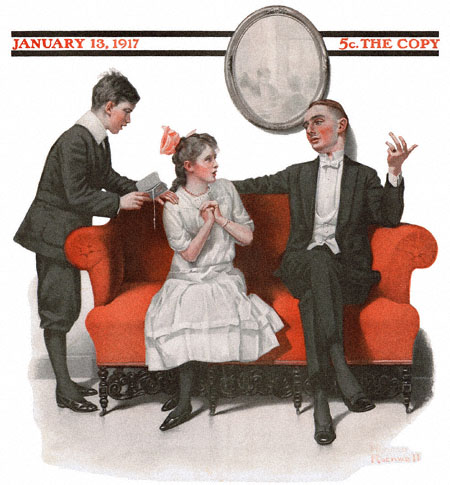
Two Men Courting Girl’s Favor, Norman Rockwell, 1917

Remember that you create half of the relationship. Anything that you do better, in either giving or receiving, can only improve the situation. Of course, you cannot arrive at a consummate marriage, a reciprocal union, from only one side. But you can move towards it. Your healthy human needs will not be adequately addressed by your stagnant partner. (This is a problem that needs a separate discussion.)   But you can grow in wisdom and love and partially reshape a relationship that will then look and feel different to both of you. Your personal growth continually renews and updates the invitation to your partner to join you in a dialogue of eros.

The soul purpose of life is to grow in capacity to love. Philosophy and psychology alone will not get you there. Love is too big of a mystery to tackle in the abstract. A bottom-up approach is needed. Start with an example, not a concept. Perhaps this soulful purpose adds to the basic desire for romantic coupling. Grow to love this specific, flawed, frustrating, infuriating, ordinary person in front of you. If you can love any one particular person unconditionally, unrestrictedly, unreservedly, then you can love anybody. Then you will know a greater love than connects all things. Ironically, what seems like an individual, one-sided endeavor actually helps you participate in something even more inclusive than your marriage. So, yes, working on “relationship issues” by yourself is still worthwhile.

In this sense, it does not absolutely matter who that specific person is. The beauty and the suffering of marriage is that any person, fully revealed, is difficult to love. Some are more difficult than others, of course, and we all might prefer a shallower learning curve. Since perfect love is not attainable and all are equally worthy of love, you are ultimately tackling the same project with whomever you choose; it just has a different shape. And it’s the same project no matter how many times you choose.

Marriage: Should I Stay or Should I Go?

Renewing or reneging on the marriage commitment is, for most people, their biggest discernment ever. Many factors go into the decision, but the core dilemma is often integrity versus suffering. Commitment means something; it has enduring power within conscience (though its limits are rarely explored). Marriage highly structures social and private life, thereby creating family. Will anyone recognize me once I am suddenly single? Will I recognize myself? A commitment to a central structure largely constitutes integrity for the married person.

farmer-and-bird-1923

Farmer and Bird – Norman Rockwell – 1923

On the other hand, divorce presents an escape hatch for a world of hurt. Humans instinctively look for the first available exit from suffering. Do I work indefinitely to improve the relationship with no guarantee of success or eject now? Ending the immediate pain and dealing with any side-effects later sounds like a big relief. It might even be the most charitable move in the short- and long-term for all concerned.

I want to put in a strong disclaimer here that in any particular marriage, the question of “should I stay or should I go” is a personal one. Family, friends, spiritual advisors and marriage counselors cannot answer the question for you and should not judge your answer afterwards. With that proviso, as an example, here are my criteria for remaining in my own marriage.

My Non-Negotiables of Marriage

The dignity of the human person has primacy in all human affairs, including marriage. You are the final guardian of your own dignity, which is the object of an appropriate self-love. If you do not love yourself, you cannot really love anybody else (and vice versa). Any kind of abuse, by definition, attacks dignity. Physical, emotional, sexual, or spiritual abuse cannot be permitted.

Marriage obviously requires active engagement from both spouses. The absence of engagement is abandonment. It is clear that if your spouse does not come home one day and is never heard from again, you’ve been abandoned. There are other ways, however, that  one can leave a marriage. When your spouse refuses to work towards mutual satisfaction in the marital relationship, you no longer have a partner and likewise, you have been left alone. Infidelity or betrayal is also a form of abandonment. You cannot be in two places at once.

Two engaged people with basic respect still have a marriage. If both parties choose to stay, there is hope. However one person may find the challenge too great and choose to go. May there be mercy either way.

Marriage Must Satisfy This Equation

The success of a marriage depends upon the relative values of four variables – really, two instances of two variables, one instance for each partner. Let’s call S the Shadow, that part of the self where wounds hide (some call them defects of character; I call them wounds). Wounds are revealed, first to oneself and then to the other, in an act of intimacy. Then let E stand for Enlightenment, a common word for maturity in many spiritual traditions. Carl Jung and others called it individuation. The “light within” that comes through spiritual and psychological maturity (wisdom) illuminates and integrates one’s shadow into the whole person (healing). In marriage, enlightenment provides visibility and calm when your partner’s shadow is cast over you.

the-ouija-board-1920

The Ouija Board – Norman Rockwell – 1920

Each partner has wounds, more or less, and each partner is enlightened, more or less, which makes for two instances of these variables. Thus we have Shusband and Swife, Ehusband and Ewife and the marriage predicate is:

(Ewife > Shusband) & (Ehusband > Swife)

E > S means that one has enough enlightenment to stand in the other’s shadow with equanimity and compassion. Put a different way, one can hold the other without becoming overwhelmed, offended, defensive, resentful.

This “equation” might seem rather obvious, but here is the real point. Nowhere is it stated what are the literal values of E and S. There is no cultural standard value of E or S. There is no threshold above which you can say, “Well, her shadow is obviously too dark” or below which you can claim, “He is a certified dimwit.” The variables are always relative – too dark for his brightness, too dimwitted for her shadow. Without objective standards there can be no blame.

Instead of deciding who is on the wrong side of the non-existent human norm, the way forward, either within the marriage or after the divorce, is two-fold. Grow further towards enlightenment and integrate more of your shadow. A couple has to meet each other half-way in this work. A newly single person wants to be in a better position for the next time.